
Should I squeeze my glutes at the top? In short, no - but you know I have more to say than that!
I put this post on Instagram yesterday…

And I felt the need to put that on my grid as a post, in it’s simplest form, because it is the most common question that comes up from new members joining my online programmes; Smart Move and The Postnatal Plan or new 1-2-1 PT clients.
The movements I am talking about here in particular are lower body exercises like squats, hinges and lunges and I’ll coach them through the movement and they’ll say - “and should I squeeze my glutes at the top…and what about the bottom?”.
And the short answer is no. There’s not one client in the last 8 years - whether that’s my 1:1 PT or my online programmes (caveat - confession on babywearing classes below) have I told anyone to do that - regardless of pelvic health related symptoms.
I had lots of my followers reply in the messages, saying that their coach, fitness, pilates instructor tells them to do this, and also fellow coaches said that they use this cue, and should they not be doing that?
But before we go on - I just want to say I really welcomed the questions, because to move forward in this space, we need to be open, ask each other questions, we need to learn from each other, I love people’s curiosity and I want to say my messages are always open if you would like my take on something like this.
So here are my thoughts…
I’m not saying that my way of approaching this is “right” but I have worked in this space for a long time now and my approach has worked and continues to work incredibly well for my clients; that’s including those who have ranging pelvic health related issues - from pelvic pain, incontinence to prolapse. I have done some incredible mentorships that have made me think very differently about movement, biomechanics, how we manage pressure in our body and how we generate power. I also have my own body as a case study, having dealt with a bad fistula six years ago which affected my pelvic health and I am always working on improving my own movement.
Before we dive in, it’s important to highlight the space I work in and who my clients are, prior to explaining my thinking further. I am a women’s movement coach. I work with women from the postpartum period, through to post-menopause. I work with all women, with or without pelvic health related issues, but I am particularly known for my expertise in helping women overcome pelvic health related issues through movement. And this is where the discussion of this cue becomes even more important; because I think people are using this cue in anticipation of it supporting pelvic health, when it could be making matters worse.
I work with women who have never lifted weights before, and the heaviest that one of my clients lifts at the moment is 85Kg. That’s important, because when you are working with much heavier weights than this, there will be different strategies to incorporate to help clients manage the lift, manage pressure in their body and to stabilise at the top of the movement and squeezing at the top may be a cue that’s used. But that’s not the population I am talking about here, and that’s not my area of expertise.
So when it comes to this cue, I want to tell you, I am not exempt from having said this in the past. You will still be able to find a video of me floating around the internet, saying “squeeze your glutes at the top”. This is from when I trained to be a babywearing exercise instructor back in the day. We learned choreographed routines to music, taught by an exercise-to-music instructor. We followed and to teach a programme designed by someone else, move for move, cue for cue. And on reflection, I think this is where a lot of these cues about squeezing your glutes come from - the aerobic/group class space - where perhaps these instructions become like filler-fodder, without thinking about why say that - what’s it achieving, is that actually helpful?
This is what I would love us to consider when instructing these movements instead.
The pelvic floor sits at the bottom of our core, it provides support for our insides above it. Its role in the squat, hinge or lunge (or any other up down movement) is to assist in supporting the pelvic organs and the contents of our core (our insides) through that transition from the floor up, as gravity works against us. I remember one of my mentors, Katie St. Clair saying, our core is essentially a sloshy bag of guts, surrounded by muscle and bone, that the pelvic floor has to shift back up.
When we ask someone to squeeze at the top, I think we are probably saying that to help “protect” the pelvic floor, possibly to help stabilise too - but it could be causing more harm than good and I discuss this more under point 3 below. But before that, these are the two most important things we need to think about first - can we perform the movement well, are we breathing well?
Positioning - Let’s take a squat as an example.
Many women have not been told how to squat properly. When women come and work with me for the first time, I’ll have them demonstrate their squat (no-judgement), and they will typically do what I call a Squ-inge. It’s a blend between a squat and a hinge. It looks like chest dropped, back arched, bum high, knees wide.
That’s the first thing I will clear up when you come and work with me. I will teach you how to do a squat, teach you how to do a hinge etc, master step 2 below, and then we add in the weights. Then we can work on progressively increasing the challenge over time.
If our set-up isn’t right, then this can affect how we manage pressure in our system and how well our pelvic floor can manage what’s being asked of it. And the reason that is important, is sometimes, we are layering on these cues and we aren’t even getting women working in a true squat or hinge in the first place.
A big focus in my work is helping my clients understand where the power is coming from in their movements, and in your lower body movements, that should be from your feet. I will touch more on this in point three, but saying “squeeze your glutes on the way back up” really interferes with the power we can produce through our feet and legs from the ground up.
The other important thing is to make sure that my clients feel comfortable, stable and safe in their movements, before anything else. You may have seen me standing on wedges in my videos, with a block between my knees, or doing a squat against a wall with a roller behind my back. We can start you seated if you struggle to find full range (get your bum low) and balance - working out what works for your body matters.
Getting clients to relax through the movements and trust their body matters. Often they will carry unnecessary tension if they feel uncertain in a movement and adding in the “squeeze” cue, whether at the top or the bottom, will layer tension on top of tension. That’s not helpful and makes them feel even more wobbly and disconnected.
Getting your set-up right goes a long way to helping you move well, build strength and manage pelvic health and once I get clients into these positions, which are better suited to their body, they’ll say “oh that makes so much sense!” or “I’ve never thought about it like that before”.
If you are reading this and thinking, that squat she’s described up there is me, come and see me for a session and we can clear it up. No one expects you to know how to do this, not all coaches coach a squat well, and there is not a one size fits all when it comes to a squat, there are so many tweaks and variations to make this feel good for you.
The Breath
Once we have got you in a good position, the breath is what I layer in next. When you breathe in, think about a cafetiere plunger moving down - just like this, the pressure moves down in our “bag of guts” towards our pelvic floor, and at the same time your diaphragm is flattening and the pelvic floor reacts by moving down subtly with the inhale - think about how a balloon expands as you blow that first breath into it.
When you exhale, the reverse happens: your pelvic floor reacts/lifts, moving into a more rested position, and so does the diaphragm.
I can’t emphasise this enough, ensuring you are timing your inhales and exhales correctly in your movement goes a long way to assisting your whole body/pelvic floor manage the pressure created by the movement.
My top cues in your squat are:
To only go as low as the air flows - i.e. when you run out of inhale, and can’t take anymore air in, don’t go any lower (this will improve in time as you get more confident with the movement).
Breathe in as you go down, through your nose.
Breathe out audibly through your mouth as you come up. Starting that exhale just before you move. I normally coach an exhale like you are “blowing out the candles”.
And I still end up reminding clients about how to do this, even when they have been training with me for years!
Mastering this is critical before loading you up with weights, because this is your in-built mechanism to help you manage load. And I am talking - loud audible exhales. If you are in one of my membership, I’m not kidding, I coach you through your inhale and exhale in every movement. I say “make sure the person in the next room can hear you” or if you are in my group sessions, I’ll say “come on ladies, I can only hear Jess breathing”.
We can be very self-conscious about breathing, especially if we are in a public setting like a gym. But you need to do it! It’s very important to manage pressure and lift heavier loads, don’t worry about what anyone else thinks. You look like a pro.
How the cue to “squeeze” interferes with squat mechanics/movement.
The cue of squeezing your glutes at the top is sometimes used, I think, to look out for a client's pelvic floor, in a protective way - but the trouble is - it’s not doing what you might think it is. Your positioning, learning how to use your feet to power up and good breathing are what’s helping you in your lower body movements the most. That means when I coach a squat or do one myself, I am not actually thinking about my pelvic floor at all - a lot of the time I will say to clients “don’t give it a second thought”.
To feel the negative-effect of the “squeeze” cue - slow down and try this…
First of all sit on a dining chair - tilt your body weight forward and push the ground away with your feet to stand up. You can use my breathing advice I’ve given above, deep breath in, exhale to stand up.
Then repeat this.
Sit down, then squeeze your back passage like you are stopping wind coming out and then try to stand up with your back passage still clenched. Notice how much harder that is bodyweight only, to get up, let alone when we add in weights. This is a great way to demonstrate the effect of this, because you won’t feel the effect of that so much, if you just do a squat starting in the usual standing position with your back passage/glutes squeezed.
When you squeeze your back passage, this will contract the pelvic floor. If you hover in your squat like this - you will feel your glutes tensing too, it creates a bit of a tuck of the pelvis underneath you. You may also feel how that adds tension to your hamstrings. This contracting of the pelvic floor interrupts the natural movement through your core canister, which cancels out that good positioning and breathing you’ve worked on. If you like getting technical, when your pelvis is tucked underneath you, it also prohibits you from transitioning through the three positional phases the pelvis ideally moves through, needed to shift yourself up to standing, without compensation from another body part.
When we squat, we want all the power coming through the feet, from a sensation I call “pushing the ground away” and up through the legs. The hips move as a result of the upward force from the feet and legs.
And to do this move well, we also need to learn the body to relax, “take the upper body out of the equation”, “like a sack of potatoes” as you will often hear me say.
Quite often that tension we are adding with the “squeeze”, is adding tension to a body that might already find it hard to relax = double whammy. The physios I have spoken to recently have said that pelvic floor over-activity is something they are seeing more and more of. Another reason not to add more tension, or ask for a squeeze, when in this situation, the pelvic floor is already in a tensioned position (or the muscle tone is higher) and probably can’t accommodate, or certainly won’t benefit from trying to squeeze more.
The questions I have received, also asked - “but what about if someone has a weak pelvic floor or prolapse?”.
Even then I will not cue a squeeze. I keep my pelvic floor strengthening (if suitable for you) in the form of Kegels, completely separate from our workouts. Your workouts will provide the movement variety, mobility and strength work, which your whole body will benefit from, including your pelvic floor.
What about the squeeze at the top? No. You do not need this. In a squat, your glutes are lengthened at the bottom of your squat, when your knees are bent and your bum is down. When you are at the top, the work has been done, you are resting. So squeezing at the top of a squat or hinge - is actually like doing a bicep curl, curling up and then trying to squeeze your bicep again, when your arm is hanging down, relaxed.
If you work with me, you will start to understand the importance of a “stacked” position in certain movements, this is from a pressure management perspective, but also to help you move with more ease. The stacked position is when your ribcage and pelvis sit on top of one another.
In the postpartum period in particular, the pelvis tends to tip forward slightly and the shoulders get pulled back, so our bodies are in more of a scissored position. If we add in the squeeze, especially when we are still in this presentation (this can remain long after having a baby by the way) this can add to even more over-extension of the spine, compression around the SI joint, back of the pelvis and pressure into the front of the hips and knees. We ideally want to find hip extension, without relying on our hips and knees to lock out and hold us up.
If you have enjoyed this and would like to receive my newsletters or blogs, please sign up here.
If you are interested in working together - please have a look around here.
Contact me here.
And before you go - if you would like my videos on how to do your pelvic floor exercises, click below to access my free, three part series:
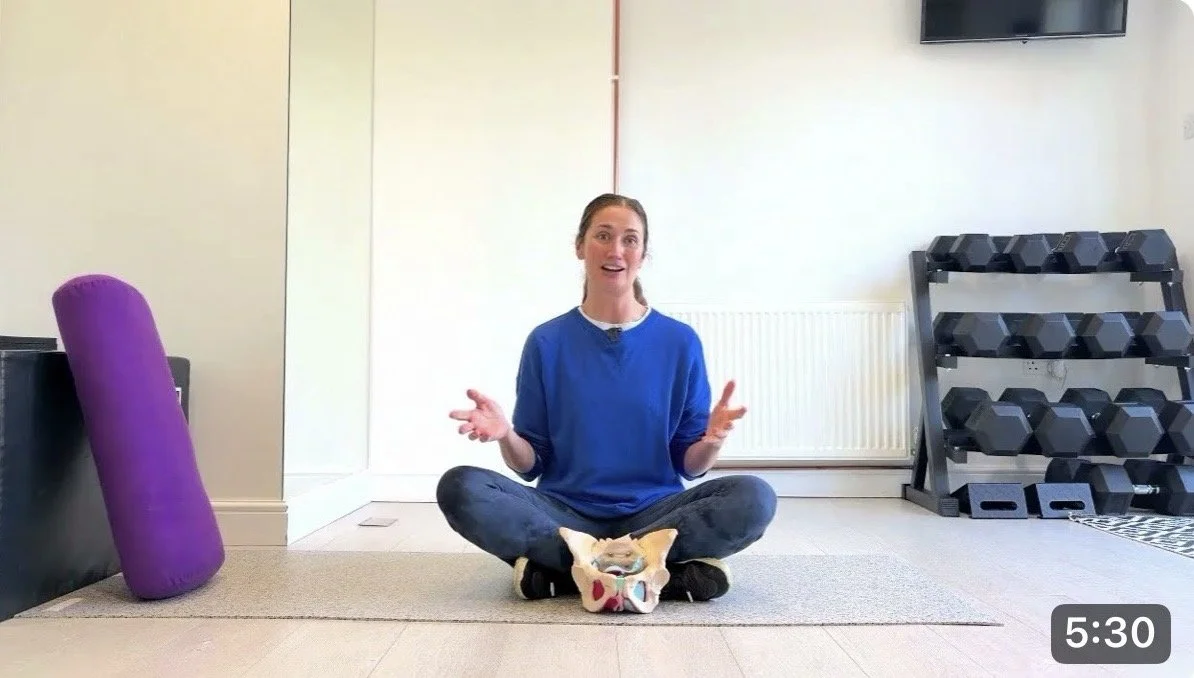
YouTube
An introduction to pelvic floor exercises
How to do your short holds
I'll talk you through them in real time and also help you understand how to adjust those if you can't quite keep to the number of reps or hold for the amount of time I'm describing. There's adaptations and a starting position for everybody.